Seven analyses that read DNA at different depths, sequenced and interpreted in our own laboratory in Skopje. This brochure explains what each one reads, who it is for, and what the report will tell you.
Stevo Crvenkovski 32-1, units 2 and 3, Skopje · +389 2 203 0424 · [email protected] · Monday to Friday, 08:00 to 16:00
DNA is extracted, sequenced and analysed in our own laboratory. Nothing is shipped to a reference laboratory abroad, which removes transit and handling from the process, keeps your data in the country, and means the geneticist who explains the result has access to the run that produced it.
Accreditation and certificate numbers are listed in the laboratory's legal documentation and confirmed on request.
They differ in one thing above all: how much of the genome they read. Wider is not automatically better. A wider test takes longer, costs more and returns more variants of uncertain meaning, so the depth is matched to the question.
| Situation | Start with | Also consider |
|---|---|---|
| Planning a pregnancy, or early in one | Carrier screening, both partners | PGT-M through IVF if both are carriers |
| A child with developmental delay, autism or unexplained symptoms | cWES, ideally with both parents | CNV analysis first; cWGS if the exome is negative |
| A known condition in the family, or a clear clinical picture | Gene panel for that condition | cWES if the panel is negative |
| Recurrent miscarriage, infertility, or a suspected chromosome condition | Karyotype | CNV analysis for smaller changes |
| A structural finding on ultrasound or karyotype | CNV analysis | cWGS to map the breakpoints |
| A newborn, in the first days of life | Newborn screening | Confirmatory testing if a result is positive |
A guide, not a prescription. Several of these are ordered by the treating doctor; all of them start with a conversation with a geneticist.
Most of us carry a few recessive variants without ever knowing. Nothing happens unless both partners carry a variant in the same gene, and then each pregnancy has a one in four chance of the condition. Carrier screening reads a set of those genes in both partners.
Best done before pregnancy, when the options are widest. If both partners carry the same condition, a geneticist explains the choices, from embryo testing through IVF (PGT-M) to prenatal diagnosis.
Copy-number variants are stretches of DNA that are deleted or duplicated. Many are harmless; some cause developmental delay, autism, epilepsy or congenital anomalies. A chromosomal microarray finds changes far below what a karyotype can see, down to tens of thousands of letters.
Copy-number changes explain roughly one in ten cases of developmental delay or autism, which is why this is often the first genetic test ordered for a child.
The exome is the 1 to 2% of the genome that codes for proteins, and it holds around 85% of the variants known to cause disease. Sequencing it reads every gene at once, which is why it is the test of choice when the symptoms do not point to one gene.
The "c" is clinical: an accredited laboratory, a validated pipeline, ACMG classification and a geneticist's signature, so the result can be used for care. Published diagnostic yield is roughly one in three to one in four; testing the child together with both parents raises it and cuts uncertain findings.
Whole genome sequencing reads all 3 billion letters: the genes, the regulatory regions between them, and the structure of the chromosomes. It sees deep intronic and non-coding variants, finds copy-number and structural changes more reliably, and covers genes the exome captures poorly.
Same clinical-grade standards as cWES. Turnaround is longer and the data much larger, so it is chosen deliberately rather than by default.
When the clinical picture points to a group of conditions, a panel reads exactly the genes known to cause them: cardiomyopathies, hereditary cancer, epilepsies, hearing loss, connective-tissue disorders and many others. Fewer genes means a faster answer and fewer uncertain findings.
If the family's variant is already known, a targeted test for that single variant is enough for relatives. If a panel is negative and suspicion remains, the same sample can move on to the exome.
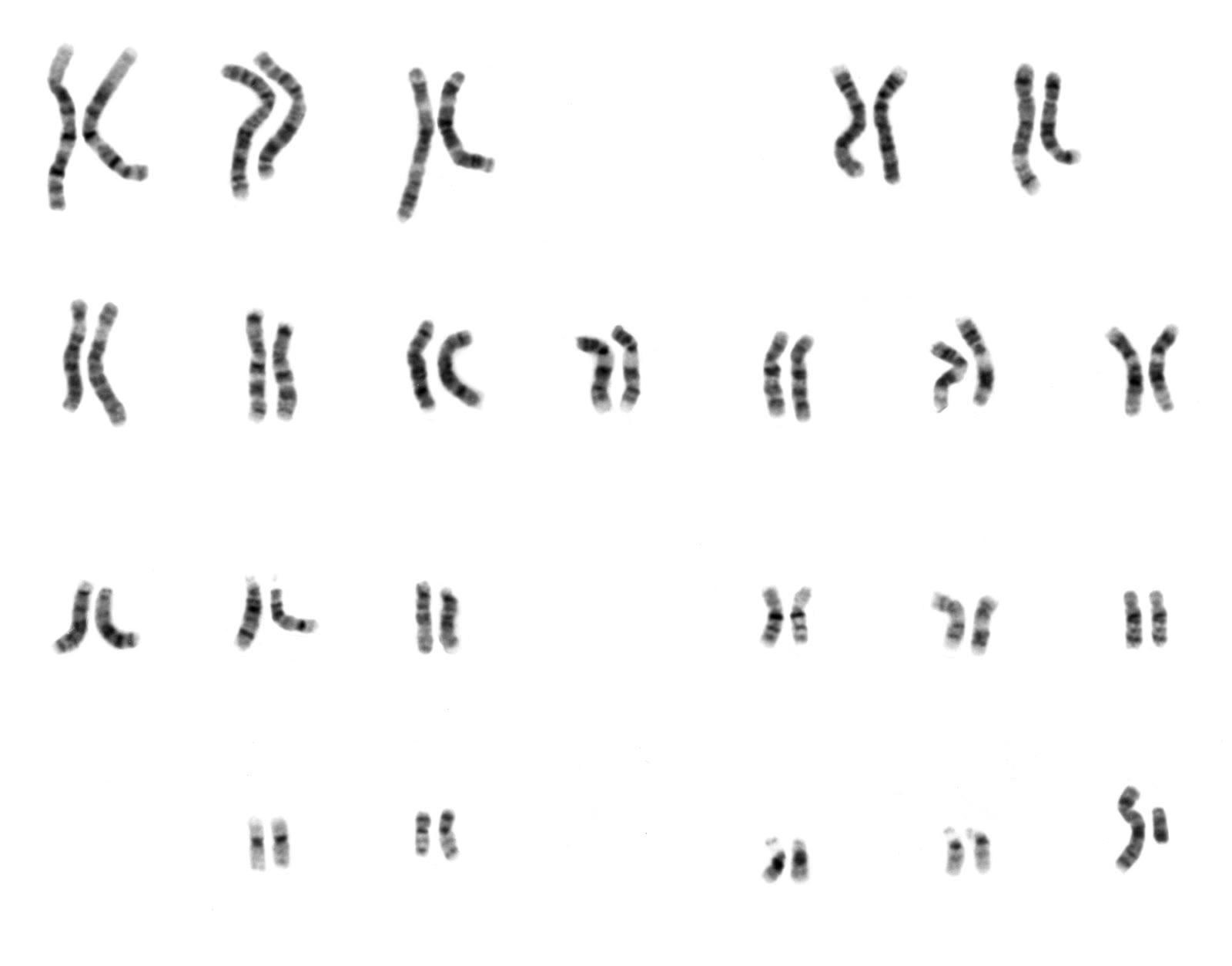
The oldest genetic test and still the right one for some questions. Cells are grown, stopped mid-division, stained and photographed, and the chromosomes are arranged in pairs. The picture shows their number and their large-scale structure.
It detects extra or missing chromosomes such as trisomy 21, Turner and Klinefelter syndrome, and large rearrangements such as balanced translocations, a common hidden cause of recurrent miscarriage. Changes smaller than a few million letters need CNV analysis instead.
Some inherited conditions show no signs at birth but cause lasting harm if treatment starts late, and are manageable if it starts early. Newborn screening looks for exactly those, from a heel-prick blood spot taken in the first days of life.
A screen-positive result is not a diagnosis. It is always confirmed with a specific test before any decision, and a geneticist explains either outcome.
Call and describe the situation. A geneticist will say which analysis answers it, what sample is needed and how long it takes.
Descriptions in this brochure are general and educational. Gene lists, resolution, turnaround, prices and accreditation details are confirmed by the laboratory. Genetic testing is done with informed consent and, for children, the consent of both parents or guardians. Results are interpreted in the context of the person's history and are not a substitute for medical care.