Home / DNA analyses
DNA analyses. From one gene to the whole genome.
Seven analyses that read DNA at different depths: a carrier screen before or during pregnancy, copy-number analysis, targeted gene panels, the clinical exome and the clinical genome, the classic karyotype, and newborn screening. Samples are processed in Skopje and every report is interpreted by a clinical geneticist.
Genetic counselling before testing is an integral part of every analysis.
Start from the question, not the technology
The choice of the right genetic analysis depends on the clinical question, the symptoms and the family history. Below are common situations and the analyses a geneticist may recommend. A conversation with the geneticist before testing helps establish which analysis suits your particular case.
| Situation | Start with | Also consider | |
|---|---|---|---|
| Planning a pregnancy, or early pregnancy | Carrier screening, both partners | PGT-M through IVF if both are carriers | |
Everyone carries several recessive genetic variants that usually cause no health problems at all. The risk of an inherited genetic disease arises when both partners carry a pathogenic variant in the same gene. In that case, each pregnancy has a 25% (1 in 4) chance that the child inherits the genetic condition. Carrier screening for genetic diseases tests a selected panel of genes in both partners, to find out whether there is an increased risk of passing an inherited genetic disease on to their children. The widest options for reproductive planning exist if the testing is done before conception. One of them is preimplantation genetic testing for monogenic diseases (PGT-M). It is done as part of in vitro fertilisation (IVF): the embryos are tested genetically, and an embryo in which the specific genetic disease has not been found is chosen for transfer to the uterus. If the genetic risk is found during pregnancy, prenatal genetic diagnosis may be recommended to establish whether the baby has inherited the specific genetic condition. Testing can start with one partner. If a pathogenic genetic variant is found, testing the other partner is recommended, to assess the risk for the children. | |||
| A child with developmental delay, autism or unexplained symptoms | cWES, ideally with both parents | CNV analysis first; cWGS if the exome is negative | |
Copy number variant (CNV) analysis has traditionally been one of the first genetic analyses recommended for children with developmental delay or autism spectrum disorders. It finds losses (deletions) or duplications of parts of the genetic material and can explain roughly 10% of cases. Whole exome sequencing (cWES) analyses the protein-coding parts of about 20,000 genes. Today it is increasingly used as the first test, or at the same time as CNV analysis. The reason is that small changes in the DNA, such as single-nucleotide substitutions and small insertions or deletions, can explain a further 25 to 33% of cases. Trio testing, which analyses samples from the child and both parents, is especially useful. It shows whether a genetic variant arose new in the child (de novo) or was inherited from one of the parents. This helps considerably in interpreting the results correctly and reduces the number of findings of uncertain clinical significance (VUS). If CNV analysis and cWES find no genetic cause and the clinical suspicion of a genetic disorder remains high, whole genome sequencing (cWGS) can be done. Unlike exome sequencing, it also covers the non-coding parts of the DNA and a wider range of structural genetic changes that cWES cannot always detect. | |||
| A known genetic disease in the family, or a clear clinical picture | Gene panel for that condition | cWES if the panel is negative | |
When the patient's symptoms or the family history point to a particular group of inherited diseases, a targeted gene panel can be used. This analysis examines specific genes known to be linked to the suspected condition. Compared with whole exome sequencing (cWES), a gene panel usually gives results faster and finds fewer variants of uncertain clinical significance (VUS). That is because the analysis is aimed at the genes where there is a specific medical suspicion. If a particular pathogenic genetic variant has already been identified in the family, other family members can have targeted genetic testing: an analysis only for the presence or absence of that specific variant. This makes it simpler and more precise to establish whether relatives carry the same genetic change. If the gene panel result is negative but the clinical symptoms still point to a possible inherited genetic disease, the investigation can continue with whole exome sequencing (cWES). | |||
| Recurrent miscarriage, infertility, or a suspected chromosomal disorder | Karyotyping | CNV analysis for detecting smaller chromosomal changes | |
Karyotyping both partners is a genetic analysis that examines the number and structure of the chromosomes. An important aim is to find balanced chromosomal translocations: structural rearrangements in which parts of chromosomes swap places, without any genetic material being lost or gained. Because of this, the carrier is usually completely healthy and has no symptoms. Even so, such a rearrangement can lead to embryos with an uneven amount of genetic material, which raises the risk of miscarriage. Balanced translocations are therefore one of the possible hidden genetic causes of recurrent miscarriage. Karyotyping can also find changes in the number or structure of the sex chromosomes, which can be linked to impaired fertility. It also makes it possible to diagnose certain chromosomal syndromes, such as Turner syndrome and Klinefelter syndrome. CNV analysis complements karyotyping, because it can find smaller chromosomal changes: deletions (losses) and duplications of genetic material that are too small to be seen with classical microscopic analysis of the chromosomes. If tissue from the pregnancy is available after a miscarriage, CNV analysis can be done on it. The result can show whether the embryo had a chromosomal change, and so help explain the possible genetic cause of that particular pregnancy loss. | |||
| A structural change seen on ultrasound or in the karyotype | CNV analysis | cWGS for further investigation of certain structural changes | |
CNV analysis makes it possible to establish the chromosomal change precisely: which part of the genetic material is affected, how large the change is, which genes it includes, and whether the same or a similar change has been described before in the medical literature and genetic databases. In balanced chromosomal rearrangements, where no genetic material is lost or gained, whole genome sequencing (cWGS) can pinpoint where the chromosomes broke and rejoined. This matters especially if one of the breakpoints lies within a gene, because it can disrupt the gene's function and lead to a genetic disorder. The final interpretation of the genetic finding is made by a medical geneticist, who considers the results together with the ultrasound findings, the clinical picture and the family history. This allows a more precise assessment of what the genetic change means and how it may affect the baby's health. | |||
| A newborn, in the first days of life | Newborn screening | A confirmatory diagnostic analysis if the screening is positive | |
Newborn screening is a preventive health programme that aims to detect certain congenital and inherited diseases early, which usually show no visible symptoms right after birth. If they are not found and treated in time, these conditions can cause serious and lasting harm to health. With an early diagnosis and timely treatment, in many cases the damage can be prevented or greatly reduced and the child's quality of life improved. Screening is usually done in the first days after birth, by taking a few drops of blood from the newborn's heel, normally within the first week of life. Expanded genetic newborn screening examines particular genes linked to inherited diseases and can include additional conditions, such as spinal muscular atrophy (SMA). In this disease, early detection and timely treatment can significantly improve the outcome of treatment and the child's further development. It is important to stress that a positive screening result does not mean the child definitely has the disease. It indicates that further tests are needed. Every positive finding must be confirmed with an appropriate diagnostic genetic test and a specialist assessment before any medical decision is made or treatment begins. | |||
This guide is for information and does not replace an individual medical assessment. Some analyses are recommended or ordered by the doctor who follows the patient. Choosing the right analysis starts with a conversation and genetic counselling.
Find out which inherited genetic variants you could pass on to your child
Most people carry a few recessive genetic variants without knowing it at all. Being a carrier usually causes no health problems. However, if both partners carry pathogenic variants in the same gene, linked to the same autosomal recessive disease, there is a risk that the child inherits the disease. In each pregnancy, the chance that the child is affected is 25%.
Carrier screening examines a group of genes linked to recessive inherited diseases in both partners.
It is best to have the analysis before a planned pregnancy, when the most options are available for informed family planning. Even so, testing can also be useful during pregnancy.
If both partners are found to carry pathogenic variants linked to the same genetic disease, the geneticist will explain the options available. These can include genetic testing of embryos as part of in vitro fertilisation (IVF) through PGT-M, or prenatal diagnosis during pregnancy.
- What is tested?A panel of genes linked to recessive genetic diseases, such as cystic fibrosis, spinal muscular atrophy, thalassaemia and many other, rarer inherited diseases. The exact range of genes to be tested is decided in consultation with the geneticist.
- Who is the analysis for?Both partners. In some cases one partner can be tested first, and the other tested if a relevant genetic variant is found in the first.
- SampleBlood or saliva, depending on the method of analysis.
- What does the report contain?Information on carrier status for the genes tested, and an estimate of the couple's risk.
Pieces of DNA that are missing or extra
Copy number variants (CNV) are changes in which certain pieces of DNA are deleted or present in extra copies. Many of these changes have no health consequences, but some can be linked to developmental delay, autism spectrum disorders, epilepsy or congenital anomalies.
A chromosomal microarray finds chromosomal changes at a much higher resolution than classical karyotyping. How small a change it can find depends on the specific platform and its resolution.
This analysis is often used in genetic diagnosis for children with developmental delay or several congenital anomalies. It can also be used to investigate further chromosomal changes seen on a prenatal ultrasound scan or on karyotyping.
- What is tested?Gains and losses of genetic material across the chromosomes, at high resolution. Standard CNV analysis is not designed to find every change in individual DNA bases; those usually need sequencing.
- Who is the analysis for?Children with developmental delay, autism spectrum disorders or congenital anomalies; prenatal samples when there is a suspicious ultrasound finding; and adults in whom a chromosomal change is suspected.
- SampleBlood. In prenatal diagnosis, amniotic fluid can also be used, depending on the clinical indication.
- What does the report contain?A description and classification of any variants found, as pathogenic, likely pathogenic or of uncertain clinical significance, with the available information on what they mean.
All 20,000 genes, read to clinical standard
The exome covers the parts of the genome that code for proteins, roughly 1 to 2% of the whole genome. These regions hold a significant share of the known genetic variants linked to inherited diseases.
Whole exome sequencing (cWES) makes it possible to examine a large number of genes at the same time. This analysis can therefore be particularly useful when the symptoms do not point to one specific gene, or when the cause of a suspected genetic disease cannot be found with more limited testing.
The “c” stands for clinical sequencing. Whether the results can be used clinically depends on the validation of the method, the laboratory standards applied, the classification of the variants and the expert interpretation of the findings. Variants are classified according to relevant professional criteria, including those of the American College of Medical Genetics and Genomics (ACMG) where they apply.
Testing the child together with both parents, known as trio analysis, can help establish whether a particular variant was inherited or arose new. This can make the results easier to interpret and reduce the uncertainty of some findings.
- What is tested?The protein-coding regions of the genes, and certain adjacent regions that matter for the correct joining of genetic sequences. The scope of the analysis depends on the method used.
- Who is the analysis for?People in whom a genetic disease is suspected but no specific causative gene has been identified; cases with a negative result from an earlier gene panel; and patients with complex or overlapping clinical symptoms.
- SampleBlood or saliva from the patient, and where possible samples from both parents, when trio testing is indicated.
- What does the report contain?Findings related to the reason for testing, with the appropriate classification and interpretation. Additional findings in genes linked to conditions for which medical measures exist may be reported in line with the laboratory's policy, the informed consent and the patient's choice.
Almost all of the DNA, not only the exome
Whole genome sequencing (cWGS) examines almost all of the genetic material, including the genes, the non-coding regions, the regulatory sequences and certain structural changes in the chromosomes.
Compared with exome sequencing, whole genome analysis can find additional genetic variants in non-coding and deep intronic regions, as well as certain copy number changes and structural rearrangements that cWES may not detect.
Clinical whole genome sequencing can be considered when an earlier exome analysis gave no diagnostic answer and the suspicion of a genetic disease remains strong. It can also be suitable in certain complex cases, or when a structural or non-coding genetic cause is suspected.
Because this analysis covers a large volume of genetic data, it needs careful planning, appropriate interpretation and genetic counselling.
- What is tested?The coding and non-coding regions of the genome, with the ability to detect different kinds of genetic variants. The range and reliability of detection depend on the method, the coverage and the bioinformatic analysis.
- Who is the analysis for?Patients in whom cWES gave no diagnostic answer and a strong clinical suspicion remains; cases with a suspected structural or non-coding genetic change; and certain complex clinical conditions.
- SampleBlood from the patient, and where possible from both parents, when family or trio testing is indicated.
- What does the report contain?Classified and interpreted genetic findings related to the reason for testing, including the relevant structural changes and copy number variants that the method used can detect. Whether additional findings are reported depends on the laboratory's policy and the informed consent.
Targeted testing of genes linked to a specific clinical question
When the symptoms or the family history point to a particular group of genetic diseases, a gene panel allows targeted testing of the genes known to be linked to those conditions.
Panels can include genes linked to cardiomyopathies, inherited forms of cancer, epilepsies, inherited hearing loss, connective tissue diseases and many other conditions.
Because a predefined list of genes is tested, a panel can give results faster and reduce the number of findings of uncertain clinical significance compared with broader analyses. This does, however, depend on the specific panel and the clinical case.
The panel is chosen in consultation with the geneticist, taking into account the symptoms, the medical records and the family history. If the result is negative and the suspicion of a genetic disease remains, moving on to whole exome sequencing can be considered.
- What is tested?A defined list of genes, from a few to several hundred, depending on the specific panel. The regions covered by the chosen method are analysed.
- Who is the analysis for?People with a known genetic disease in the family, or whose symptoms match a recognised group of genetic disorders.
- SampleBlood or saliva, depending on the method of analysis.
- What does the report contain?Results for the genes tested, with classification and interpretation of the relevant genetic variants, and information on what they may mean for the patient and family members.
All 46 chromosomes: their number and larger structural changes
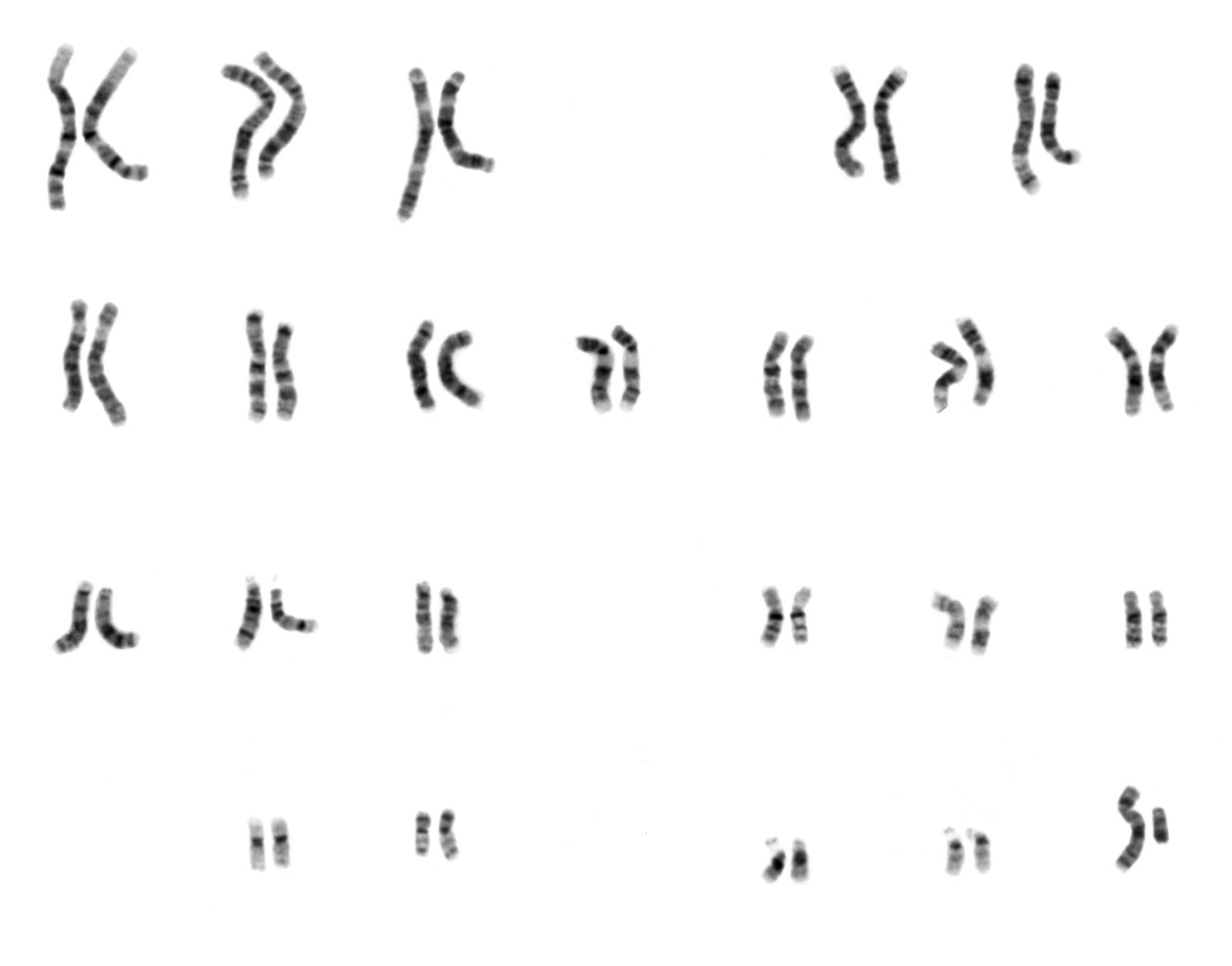
Karyotyping is a traditional cytogenetic analysis that still plays an important role in diagnosing certain chromosomal disorders.
Cells from the sample are grown in the laboratory, stopped at a particular stage of cell division, stained and examined under the microscope. The chromosomes are arranged in pairs, which makes it possible to assess their number and larger structural changes.
Karyotyping can find extra or missing chromosomes, as in trisomy 21 (Down syndrome), Turner syndrome and Klinefelter syndrome. It can also find larger chromosomal rearrangements, including balanced translocations, which can be linked to recurrent miscarriage or reproductive problems.
Smaller chromosomal changes that cannot be seen with karyotyping may need further analysis, such as CNV analysis.
- Who is the analysis for?People with recurrent miscarriage, certain forms of infertility, a suspected chromosomal syndrome, or a need for prenatal diagnosis. It may also be indicated for members of a family in which a chromosomal translocation has been found.
- SampleBlood. For certain prenatal analyses, amniotic fluid can be used.
- What does the report contain?The karyotype, given in standard cytogenetic notation, with an explanation of any changes found and what they may mean for the patient and family members.
A few drops of blood in the first days of life can help detect treatable diseases early
Some inherited diseases cause no visible symptoms right after birth, but can lead to serious and lasting consequences if treatment does not start in time. Early detection allows appropriate monitoring and treatment for conditions where medical interventions are available.
Newborn screening is done in newborns to detect certain diseases early. Usually a few drops of blood are taken from the heel and placed on a special filter card in the first days of life, according to the protocol in use.
Classic newborn screening programmes cover diseases such as phenylketonuria and congenital hypothyroidism and, depending on the programme, may also cover cystic fibrosis.
Expanded genetic screening can test for additional inherited diseases, including spinal muscular atrophy, in which starting the right treatment early can significantly affect the outcome.
Important: a positive screening result does not automatically mean the newborn has the disease. Further confirmatory diagnostic tests are needed before any medical decision is made.
- What is tested?Depending on the type of screening, biochemical, metabolic or genetic markers linked to diseases that can be detected early in life are analysed. Expanded genetic screening may also include sequencing genes linked to specific diseases.
- Who is the analysis for?Newborns, in the period recommended by the screening protocol in use.
- SampleA drop of blood taken from the newborn's heel and placed on a special filter card, where this method is used.
- What does the report contain?The result shows whether the screening is negative, or whether further testing is needed because of a positive or doubtful finding. If the result is positive, appropriate confirmatory testing and a consultation with the relevant specialist are recommended. The geneticist can help explain the results and the next steps.
Frequently asked questions
For more information about genetic analyses, the tests available and how they are carried out, please contact the laboratory.
Panel, exome or genome: what is the difference?
The main difference between these genetic analyses is how much of the genetic material is examined.
- Gene panel: analyses a preselected group of genes known to be linked to a particular disease or group of diseases.
- Whole exome sequencing (cWES): analyses the protein-coding parts of all genes, the parts of the DNA that hold the instructions for making proteins.
- Whole genome sequencing (cWGS): analyses almost all of the genetic material, both coding and non-coding regions, including the parts of the DNA between the genes.
A broader genetic analysis is not always the better choice. It can take more time and money, and at the same time find more genetic variants whose clinical significance is not fully clear.
That is why the choice of analysis is made by the medical geneticist, based on the symptoms, the personal and family medical history, and the specific clinical question to be answered.
What does the letter "c" in cWES and cWGS stand for?
The letter "c" stands for clinical sequencing: a genetic analysis intended for use in medical practice and for making clinical decisions.
These analyses are carried out in accredited laboratories, using validated laboratory methods and quality control procedures. The genetic variants found are interpreted and classified according to internationally accepted criteria, and the results are given in an official medical report signed by an appropriate medical specialist, usually a clinical geneticist.
Research sequencing, by contrast, is used mainly for scientific purposes and does not have to meet all the laboratory and diagnostic standards needed for medical decisions.
What is a variant of uncertain clinical significance (VUS)?
A variant of uncertain clinical significance (VUS) is a change in the DNA for which, on the scientific and medical knowledge currently available, it cannot yet be said with certainty whether it is harmless or can cause disease.
Over time, as new scientific evidence is gathered, many of these variants turn out to have no harmful effect on health.
Such findings are listed in the genetic report and explained by the medical geneticist. As scientific knowledge advances, they can be reassessed and their classification can change.
It is important to know that a variant of uncertain clinical significance is not a confirmed genetic diagnosis and is not, on its own, a basis for medical decisions or for starting treatment.
Will I also find out about genetic changes I did not ask about?
Only if you agree to it. In whole exome (cWES) or whole genome (cWGS) sequencing, besides the genetic changes related to the reason for testing, so-called secondary or incidental findings can also be found.
These are genetic changes that are not related to the main reason for the test, but may point to a higher risk of certain inherited diseases for which prevention, monitoring or timely treatment is possible.
During genetic counselling you will be told about possible secondary findings and can decide whether you want them reported, based on a predefined list of genes and current medical recommendations.
Can genetic testing be done on a child?
Yes. Genetic testing of a child can be done with the consent of both parents or the legal guardians, especially when the results matter for making a diagnosis, monitoring the child's health or choosing the right treatment.
For genetic diseases that appear in adulthood and for which no medical measures need to be taken in childhood, testing is usually considered carefully and, in many cases, it is recommended to wait until the child can make an informed decision on their own.
The aim is to protect the child's health, privacy and future right to decide about their own genetic information.
How long does it take to get the results?
How long a genetic analysis takes depends on the type and complexity of the test. For some analyses, such as karyotyping or gene panels, results can be available within a few days, while more complex analyses, such as whole exome or genome sequencing (cWES/cWGS), can take several weeks.
For exact information on the turnaround of a particular analysis, please contact the laboratory.
Which other genetic analyses are available?
Besides the genetic analyses listed here, the laboratory also offers other specialised tests, including prenatal genetic screening, testing to establish biological relationship, and molecular tumour profiling, which helps in choosing and guiding the right therapy.
Not sure which analysis you need?
That is exactly why the first conversation matters.
Contact the laboratory and explain your situation. The geneticist will help you understand which analysis best fits your needs, what sample is needed and how long it takes to get the results.
Important notesAll descriptions of the genetic analyses are general and for information. The exact scope of the analyses, including the genes tested, the resolution of the tests, the time needed to get the results, the prices and information on the laboratory's accreditation, is confirmed directly with the laboratory before testing.
Genetic testing is carried out with the prior informed consent of the person being tested and, for children, with the consent of the parents or legal guardians, in line with the regulations in force.
The results of genetic analyses are interpreted by a medical geneticist, taking into account the personal and family medical history, the clinical symptoms and other relevant medical findings.
Genetic testing is part of a medical assessment and does not replace a medical examination, a diagnostic assessment or appropriate medical care.